
The Roof Problems Most Homeowners Misdiagnose
Most homeowners misdiagnose roof problems and pay for it later. Learn the common roofing mistakes, hidden causes of leaks, repair red flags, and what actually saves money.
4/24/20266 min read
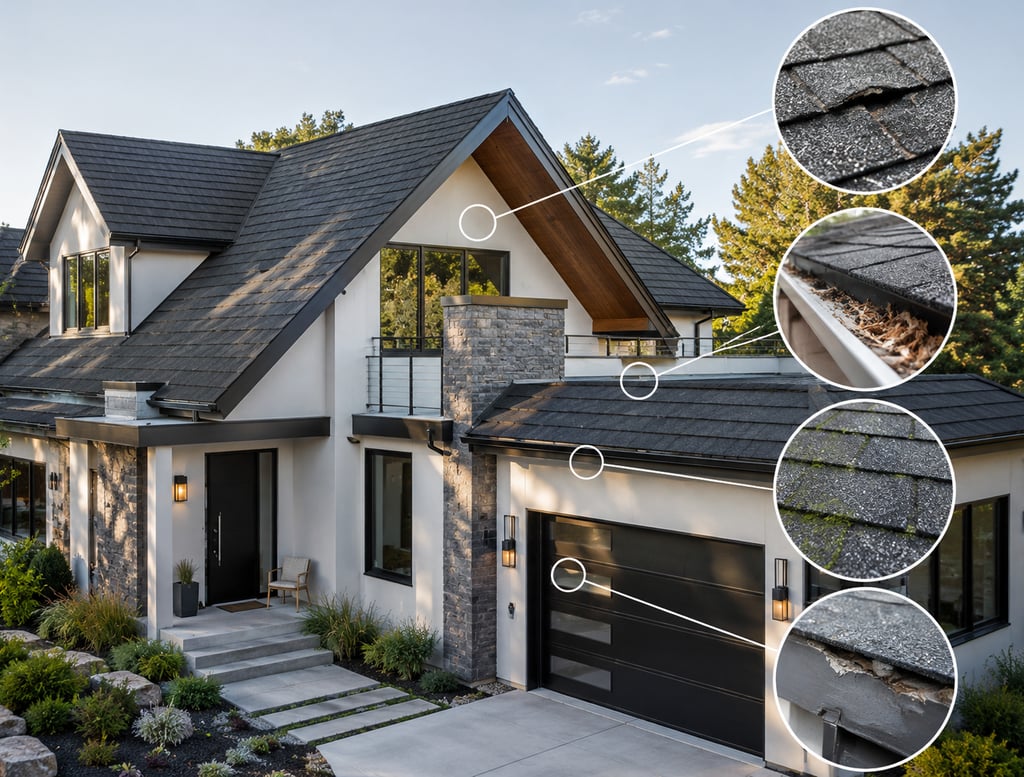
Most homeowners do not ignore roof problems because they are careless.
They ignore them because roofing symptoms are deceptively convincing.
A stain appears on the ceiling, so the leak must be directly above it.
Water spills near the edge of the house, so the gutters must be the culprit.
A few shingles go missing after a storm, so replacing those should solve the issue.
That logic feels reasonable.
Sometimes it’s even right.
But roofing problems are one of the most commonly misdiagnosed home issues because what you see is often the symptom, not the cause.
That distinction matters.
Fixing the wrong problem wastes money.
Delaying the real problem costs even more.
And in places like Huntsville, where roofs take a beating from humid summers, heavy rain, sudden wind events, and occasional freeze-thaw cycles, guessing gets expensive fast.
This is where many homeowners learn an uncomfortable lesson.
Roofing problems are rarely as straightforward as they look from the driveway.
Here are the roof issues homeowners misdiagnose most often, what’s actually happening, and what usually saves money.
1. “The Leak Is Right Above the Water Stain”
This is probably the most common homeowner assumption.
And one of the most expensive.
The logic feels obvious.
You see a stain in the ceiling.
You assume the roof failed directly above that location.
Makes sense.
Unfortunately, roofs do not always cooperate with common sense.
Water travels.
That’s the first thing homeowners underestimate.
Moisture entering through one point on the roof may move along decking, framing, insulation, rafters, or structural seams before finally becoming visible somewhere completely different.
That means the visible stain may be nowhere near the actual entry point.
A leak over the garage may show up near a hallway.
A flashing failure near a vent may create staining several feet away.
A roof penetration issue may masquerade as a leak in an unrelated room.
This is where DIY guesswork becomes expensive.
Homeowners often:
patch the area directly above the stain
replace the wrong shingles
assume the issue is resolved when staining dries temporarily
ignore attic inspection entirely
Then the next heavy rain proves otherwise.
What actually saves money:
Treat the stain as evidence of water, not evidence of exact leak location.
Those are not the same thing.
2. “Missing Shingles Are the Whole Problem”
Few roofing issues trigger immediate homeowner anxiety like missing shingles.
They’re visible.
Easy to understand.
Emotionally dramatic.
And yes, missing shingles absolutely matter.
But the mistake is assuming the missing shingles are the full problem.
Sometimes they are.
Sometimes they are the symptom of something larger.
Shingles can fail because of:
wind uplift
brittle aging materials
improper installation
fastening issues
poor edge detailing
prior storm weakening
manufacturing wear over time
Replacing visible missing shingles without understanding why they failed is like replacing one dead light bulb while ignoring faulty wiring.
You might get lucky.
Or you may simply delay the bigger issue.
This is especially true after storms.
Visible damage from the ground often understates actual roof impact.
Lifted shingles that haven’t detached yet.
Creased tabs.
Compromised seals.
Granule loss.
Hidden edge damage.
Homeowners tend to focus on obvious missing pieces because obvious problems feel easier to solve.
Roof systems are usually more complicated than that.
What contractors won’t always say upfront:
A cheap visible patch can feel satisfying while leaving broader vulnerabilities untouched.
That does not mean every missing shingle means major repairs.
It means diagnosis matters more than the obvious symptom.
3. “It’s a Gutter Problem”
This gets blamed constantly.
Sometimes correctly.
Sometimes not even close.
Gutters are visible, which makes them emotionally convenient suspects.
If water spills over the side of the house…
If fascia looks wet…
If moisture shows up near roof edges…
It’s easy to assume gutters caused everything.
And yes, clogged or failing gutters absolutely create real roof problems.
Overflow can:
force water under roof edges
damage fascia boards
create soffit moisture intrusion
contribute to rot
increase drainage-related structural wear
But homeowners also blame gutters for issues that originate elsewhere.
Flashing failures.
Roof penetration leaks.
Poor roof slope drainage.
Valley failures.
Improper installation details.
Vent boot deterioration.
The reverse happens too.
People assume the roof is leaking when the actual issue is bad drainage.
This matters because fixing gutters when the roof is failing solves nothing.
And replacing roofing when drainage is the actual problem wastes money.
Before making assumptions, ask:
Does overflow happen only during heavy rain?
Are downspouts draining properly?
Are clogs visible?
Is water appearing only in specific storm conditions?
The symptom alone does not confirm the cause.
4. “It’s Probably Just Condensation”
This one gets expensive because it sounds reassuring.
Condensation feels manageable.
A leak feels serious.
So homeowners often choose the explanation that feels emotionally cheaper.
And yes, attic condensation is absolutely real.
Especially in humid climates.
Especially where:
attic ventilation is poor
bathroom exhaust vents terminate incorrectly
indoor humidity stays high
HVAC systems create moisture imbalance
insulation performance is compromised
Huntsville homeowners see this more than people realize.
Humid summers plus poor attic airflow create ugly moisture conditions fast.
But here’s the expensive mistake:
Not every moisture issue is condensation.
And “probably condensation” becomes a dangerous placeholder when nobody actually confirms the cause.
What homeowners do:
“Let’s watch it.”
Then months pass.
Then mold appears.
Then insulation damage gets discovered.
Then decking deterioration becomes visible.
This is where false reassurance costs money.
If moisture appears repeatedly, assume uncertainty—not safety.
5. “The Roof Looks Fine From the Ground”
Understandable.
Also unreliable.
Most homeowners are not climbing roofs.
And frankly, many should not.
So the ground-level visual inspection becomes the default decision-making tool.
No sagging?
No obvious holes?
No shingles in the yard?
Probably fine.
That assumption fails all the time.
Many expensive roof problems are not visible from the driveway.
Examples:
lifted shingles
broken seals
flashing separation
fastener exposure
subtle storm bruising
vent boot failures
hidden punctures
localized wear zones
Ground-level visibility tells you very little about condition quality.
It tells you whether catastrophic damage is obvious.
That’s not the same thing.
A roof can look visually acceptable while already allowing moisture intrusion.
This is one of the reasons storm-related roof issues get underestimated.
Homeowners assume dramatic damage would be obvious.
Often it is not.
6. “That Leak Is Small, So It Can Wait”
This logic sounds financially responsible.
Prioritize bigger problems first.
Fair.
The problem is that water damage does not care how emotionally manageable the leak feels.
A tiny drip may seem harmless.
An occasional stain may seem minor.
A leak that only appears during major storms may feel easy to postpone.
But leak size does not determine urgency.
Cause does.
Location does.
Frequency does.
What a “small” leak may quietly damage:
decking
framing
insulation
drywall
electrical systems
paint finishes
mold-prone enclosed spaces
And because water damage compounds, delay often expands scope dramatically.
A $500–$1,500 repair problem can become a much uglier restoration problem if moisture keeps moving.
That doesn’t mean panic over every drip.
It means size alone is a bad decision framework.
7. “I Fixed It Myself”
Sometimes homeowners absolutely can solve small roofing-related issues.
No argument there.
But this is where temporary fixes create expensive false confidence.
Common examples:
roof sealant patches
caulk around suspicious seams
patch tape
emergency tarps
improvised flashing
DIY shingle replacement without root-cause diagnosis
Temporary intervention is not inherently bad.
The problem is when temporary becomes assumed permanent.
Because many homeowner repairs address visible symptoms.
Not underlying failure conditions.
A patch may redirect water.
Delay intrusion.
Mask symptoms.
But unresolved failure points often remain active.
Storm conditions expose that quickly.
For situations where symptoms are visible but the actual failure mechanism is unclear, experienced evaluation often matters more than guesswork. Roofing professionals like Fleming exist within that broader homeowner decision ecosystem where accurate diagnosis prevents unnecessary repair spending.
The key lesson:
Repair and diagnosis are not interchangeable.
8. “Insurance Will Take Care of It”
This assumption causes real financial frustration.
Homeowners often overestimate what insurance actually covers.
Insurance may help when damage results from covered events.
Storm impact.
Wind damage.
Sudden incidents.
But gradual neglect?
Deferred maintenance?
Aging wear?
Poor upkeep?
Usually much less homeowner-friendly.
Coverage depends on:
exact policy language
cause of loss
documentation
claim timing
exclusions
maintenance history
Waiting too long can complicate claims.
Poor documentation weakens claims.
Assuming approval before diagnosis creates expensive planning mistakes.
Insurance is not a maintenance strategy.
9. “If There’s a Roof Problem, I Probably Need a New Roof”
This is the opposite mistake.
Instead of underreacting, homeowners catastrophize.
A leak appears.
A few damaged shingles show up.
Someone mentions storm exposure.
And suddenly the assumption becomes full replacement.
That fear causes delay too.
Because if homeowners assume the worst, avoidance becomes emotionally easier.
Small manageable problems get ignored because the imagined solution feels overwhelming.
That’s how repairable issues become replacement conversations.
Not every roof issue requires replacement.
Not every quote recommending replacement reflects your only option either.
This is where comparison matters.
10. “All Roofing Quotes Are Solving the Same Problem”
Dangerous assumption.
Homeowners often compare roofing quotes like they are pricing identical work.
They may not be.
Different contractors may diagnose entirely different root causes.
One identifies flashing failure.
Another blames decking deterioration.
Another recommends broader replacement.
Another proposes spot repair.
Price without diagnostic alignment is meaningless.
The cheapest quote for the wrong issue is still expensive.
Before comparing numbers, compare:
diagnosis
scope
evidence
exclusions
materials
warranty terms
This saves money constantly.
Final Takeaway
Roofing gets expensive when homeowners confidently solve the wrong problem.
The visible symptom is rarely the whole story.
Water travels.
Storm damage hides.
Temporary fixes create false confidence.
Insurance assumptions disappoint.
Ground-level inspections miss things.
Do this before spending money:
✔ Identify the actual symptom
✔ Challenge your first assumption
✔ Separate diagnosis from repair pricing
✔ Get written scope details
✔ Act sooner if water is involved
The sooner the real issue gets handled, the cheaper roofing problems usually stay.

©2026